

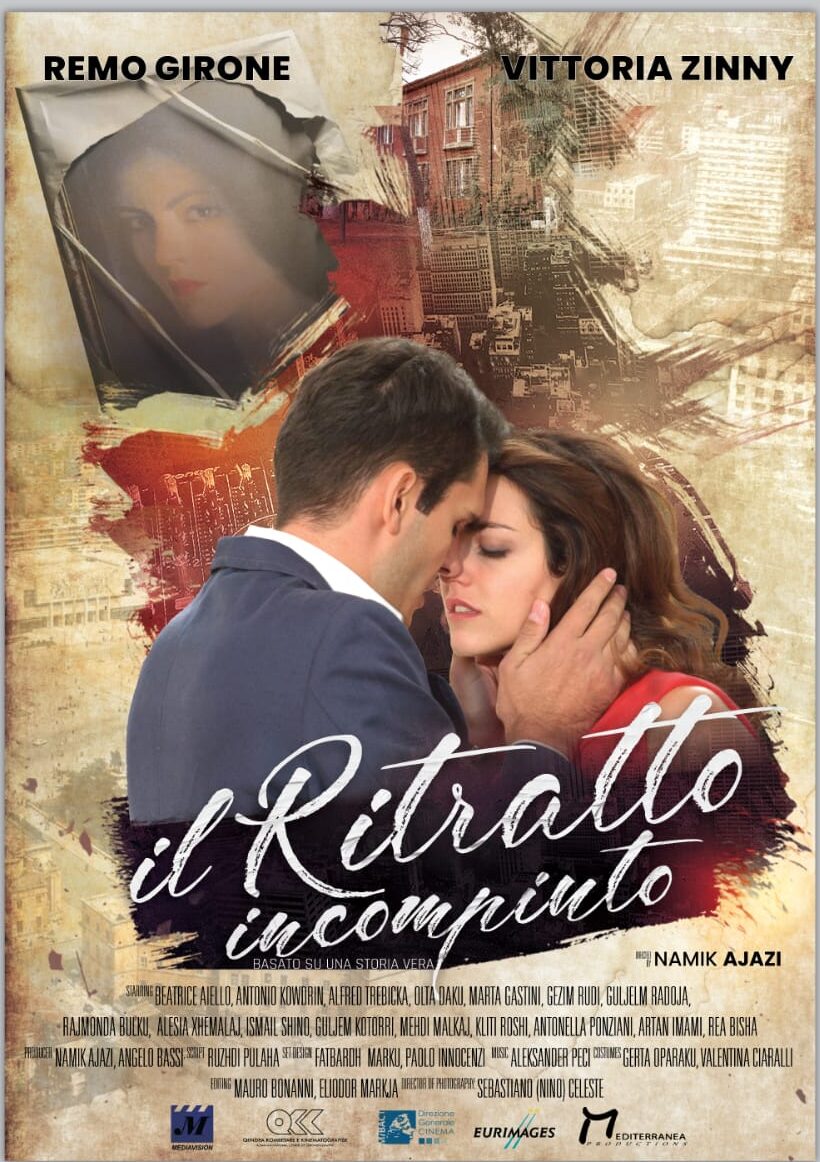
THE UNFINISHED PORTRAIT
By Namik Ajazi, Film Director
Like many cinematic works inspired by real events and subsequently reimagined through fiction, The Unfinished Portrait originates in a true story—one that bears witness to the intimate tragedies of a society in which even love could become an act of defiance.
In the early 1980s, along Tirana’s principal promenade, a young couple attracted the attention of passers-by as they strolled through the crowds, impeccably dressed and seemingly oblivious to the world around them. At the time, Tirana was a relatively small capital, where people knew one another, at least by sight, and any unusual occurrence quickly became the subject of public discussion.
Whispers circulated that the young woman was a foreigner and, more astonishingly, the daughter of the Italian Embassy’s chargé d’affaires. What seemed almost inconceivable was the suggestion that their relationship had, for a time, been tolerated by a regime founded upon the rigid ideological principles of the dictatorship of the proletariat.
A few months later, the couple vanished from public view. Rumours soon emerged that the young man had been imprisoned because of their relationship.
I was a contemporary of his, and, like several of my friends, I was profoundly affected by the story. The circumstances surrounding the couple, the rumours that enveloped their relationship and, above all, its tragic denouement left an indelible impression on me.
It was only later that I learned the young man’s name: Ernest Tushe. He had endured lengthy interrogations before being sentenced. Beyond that, little was known. In those days, information travelled in fragments, passed from one person to another in hushed conversations, before gradually giving way to the next whispered account.
Yet the story remained with me. What struck me most was the power of a feeling that refused to submit to the invisible boundaries imposed by the regime. In a society where ideological conformity governed even the most intimate dimensions of human existence, falling in love with a foreign woman could be regarded as an act of transgression.
From Memory to the Cinematic Image
In 1995, a few years after the collapse of the communist system, I entered the archives of the former Ministry of Internal Affairs for the first time. We were preparing a series of documentary films, and I needed to consult archival files relating to our research.
Alongside the material required for the project, I asked the archivist whether he knew anything about the story that had stayed with me for so many years.
He was a former prisoner who had spent several years in the same prison camp as Ernest and was therefore familiar with the circumstances. His response revealed a far broader reality: Ernest’s experience was not an isolated case. The archives contained six additional files documenting similar relationships and their consequences.
That discovery awakened my curiosity. I resolved to return to the files, convinced that these stories deserved to be recovered from the margins of collective memory and given a cinematic form.
After completing and presenting my first feature film, Amanet, which received a highly favourable response, I returned to an ambition I had nurtured for years: to bring the story of a forbidden love to the screen. Amanet explored the internal power struggles within the upper echelons of the communist hierarchy, focusing on a senior State Security official. My next undertaking would turn towards a different, yet equally revealing, dimension of that system: the intrusion of political authority into private life.
I met with Ernest, whom I had known for some time, and invited him to recount his experience in greater detail, including the events that had unfolded after his imprisonment.
He told me that he had preserved an excellent relationship with his former girlfriend and her family. Indeed, they had offered him substantial support when, following his release from prison, he left Albania during the mass exodus to Italy.
I subsequently approached my friend, the writer and screenwriter Ruzhdi Pulaha, and proposed that we develop the story into a screenplay and begin work on a new film.
Once the screenplay was completed, I met Nesti for coffee. With a smile, I suggested that we make an agreement between friends. Since his experience constituted the principal inspiration for the film, he would refrain from presenting the story publicly as exclusively his own, in recognition of the other six men whose experiences shared similarities with his.
Our intention was to honour all those who had endured persecution and suffering because they had fallen in love with foreign women. Beyond the individual stories, we wanted to acknowledge a broader human experience: the price people were forced to pay when their private affections crossed the boundaries dictated by an authoritarian state.
Reconstructing an Era
Preparing the film was a demanding undertaking. We had to return to the Albania of the 1980s, reconstructing not merely the physical environment but also the visual language, costumes, gestures and social attitudes that defined everyday life under the dictatorship.
Together with the painter and production designer Fatbardh Marku, I explored Tirana in search of the few locations that had remained relatively unchanged since that period. Every street and surviving architectural detail became a potential fragment of the world we sought to recreate.
The costumes required the same meticulous attention, while assembling the cast proved to be an even greater challenge. Each element had to contribute to a coherent reconstruction of the period, allowing the story to unfold within a credible historical and emotional landscape.
Through considerable effort and perseverance, we gradually brought the various elements together. The casting process was greatly facilitated by my friend Alfred Trebicka, an accomplished actor and lecturer who worked alongside me as casting director.
We entrusted the leading roles of Clara and Artur to Beatrice Aiello and Anton Kodrinaj. The distinguished actors Remo Girone and Vittoria Zinny portrayed Clara’s parents, while Rajmonda Bulku and Gulielm Radoja embodied Artur’s parents. Marta Gastini, a familiar presence on Italian screens, also joined the cast.
The remaining roles were carefully assigned to talented performers from Albanian theatre and cinema, whose contributions helped establish the authenticity and emotional depth of the film.
Once again, I entrusted the cinematography to Nino Celeste, whose extensive experience in Italian and international cinema was invaluable to the project.
Production lasted two months, with filming taking place in Tirana, Krujë and Lezhë, as well as in Rome. We also brought a team of special-effects specialists from Italy to help recreate the visual atmosphere of the period with greater historical credibility.
When the Past Meets the Present
Of all the memories associated with the production, one moment remains particularly vivid: Nesti’s visit to the set.
Although he had promised to come, he eventually found that he could not remain absent from a project so closely connected to his own life. One day, I spotted him standing on the opposite pavement. I immediately stopped filming, took Beatrice by the hand and walked towards him.
“This is the real Artur,” I told her.
She looked at him and embraced him warmly.
Overcome with emotion, his eyes filled with tears, Nesti thanked us once again for bringing his story to the screen.
A photograph of the two of them together, captured by our still photographer, remains one of the most treasured memories of the entire production. For me, that encounter represented something far greater than a meeting between the inspiration behind a character and the actress portraying him. It was a moment in which cinema, memory and lived experience converged, briefly dissolving the distance between the past and its representation.
I take great satisfaction in having completed a film that approaches history with such care, restoring its atmosphere and human complexity through a meticulous attention to detail. I believe this is particularly important for younger generations, who may perceive that era as remote, yet continue to live with the consequences of its legacy.
The Unfinished Portrait received several awards at international film festivals. Nevertheless, the greatest reward for me was the emotional response and warm reception of Albanian audiences. Their engagement reaffirmed my conviction that cinema can serve not only as an art form, but also as a means of preserving memory and reopening conversations that history has left unresolved.
One final episode deserves special mention: the presence of Carla Sferlazo, the ambassador’s daughter, at the film’s premiere at the Casa del Cinema in Rome.
Accompanied by her Italian husband, she met with us and offered her congratulations on the work we had accomplished. Her presence transformed the occasion into an especially moving encounter, bringing together the real-life history that had inspired the film and the cinematic interpretation through which it had been revisited.
It was a moment that resonated deeply with everyone present, a reminder that behind every historical narrative lie real individuals, personal memories and lives that continue long after the events themselves have passed.
The Stories History Leaves Behind
Today, these impressions and memories return to me as a reflection on the journey behind The Unfinished Portrait and on the responsibility that accompanies the act of bringing forgotten histories back into public consciousness.
Cinema allows us to revisit the past not simply to reconstruct what happened, but to examine what those events reveal about human dignity, individual freedom and the enduring power of personal choice. In telling the story of forbidden love, we sought to illuminate a society in which the boundaries between the political and the personal were relentlessly enforced—and in which an intimate relationship could become a matter of ideological significance.
Our next project will turn to another painful chapter of Albania’s history: the 1973 uprising of political prisoners at the infamous Spaç Prison. It is another story that demands to be remembered, examined and brought before contemporary audiences with the seriousness it deserves.
Some stories survive because they are preserved in archives. Others endure because they remain alive in the memories of those who experienced them. The task of cinema is to bring these two dimensions together, transforming individual testimony into a shared cultural memory.
With The Unfinished Portrait, we sought to give form to one such story: a portrait of love, repression and human resilience that, despite the passage of time, remains unfinished in the broader narrative of our collective past.
Namik Ajazi
Film Director